Saturday, September 29, 2012

Sharing Web Resources-NAEYC

This week, I received the most recent e-newsletter from NAEYC, “NAEYC Affiliate Connections” (2012).  As a member-at-large on the state governing board it is important to keep abreast of the issues and position statements and advocacy work being conducted by the National association.  The current issue highlighted the launch of online interest forums.  There are twenty different communities of learning currently posting discussions, suggestions and questions.  The most popular group is the “Play, Policy, and Practice” forum.  In addition to updates on legislation that will impact the work of early childhood professionals, there is a link that encourages people to register to vote, by connecting people to their local voter registration information. 
            There is information on the upcoming National Conference and the National Institute for Early Childhood Professional Development in San Francisco in June 2012.  The professional development institute is focusing the conference on developmentally appropriate practice.  The summary lists three core considerations:
            1.  knowing about child development and learning
            2.  knowing what is individually appropriate
            3.  knowing what is culturally important
            The NAEYC website’s “Public Policy” section informed readers that Congress will be voting on the end of or the continuation of tax cuts to the wealthy when they return to Washington, D.C. after the election.  If tax cuts continue, the reduced revenue will require cuts to federal programs impacting young children and their families.  The Child Care Development Block Grant will be cut by $187 million in one year.
            The “Position Statements” section provides free access to NAEYC position statements; readers can choose the two-page summaries called “Where We Stand,” or read the full-versions, which are also available in Spanish. 
            A section that caught my attention is titled “Research News You Can Use.”  The current article summarized a research review on the importance of play.  I was intrigued and concerned that the article, “Pretend Play is Important, but its role in learning is complex,” concluded that “The pattern of findings does not support a claim that pretend play is the primary driver of children’s development across a range of other areas of interest” (Snow, n.d.).

            The September issue of Young Children (2012) contains an article that highlights the national focus on school readiness, and presents that neuroscience suggests that school readiness is a function of the brain foundations that occur in the first three years of life (Peterson, 2012).  Peterson (2012) claims “The infant/toddler field owns the concept of school readiness because we are devoted to having the enduring, nurturing relationships with young children that help create the healthy brain (p. 13). The article is a great summary of the ways early caregivers support the developing brain.
            Finally, I just received my copy of the “Teaching Young Children (TYC)” publication.  The article I chose provided strategies for documenting assessment opportunities during the teaching day.  I especially appreciated the sample conversation starters for teachers to use with children.  It is great language modeling for teaching staff that may be struggling (Jablon, Stetson & Dombro, 2012).


References
Jablon, J., Stetson, C., & Dombro, A. L. (2012). Powerful Interactions. A bridge between teaching and assessment. Teaching Young Children, 5(5), 18-20,

National Association for the Education of Young Children (NAEYC). (2012, September 28) NAEYC Affiliate Connections. Retrieved from http://newsmanager.commpartners.com/naeycac/issues/2012-09-20.html

Peterson, S. (2012). School readiness for infants and toddlers? Really? Yes, really! Young Children, 67(4), 10-13.

Snow, K. (n.d.) Research news you can use:  Pretend play is important but its role in learning is complex.  Retrieved September 28, 2010 from http://www.naeyc.org/content/research-news-pretend-play-is-important


Saturday, September 22, 2012

Getting to Know an International Contact


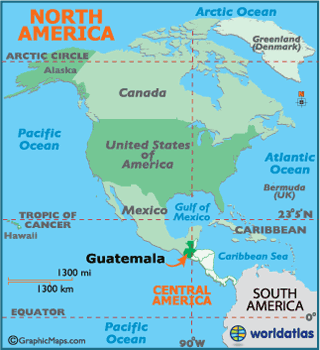
Ivonne Madariaga is a school principal of pre-primary education in Guatemala City, Guatemala.  She has been a teacher and now administrator for more than twenty years.  To become a teacher in Guatemala you must obtain a teaching certificate that is earned by completing a diversified studies program at a vocational school.  Teachers must also complete continuing education courses each year.  The training is provided by the Ministry of Education. 
            The children in the pre-primary school attend classes for a half day.  In addition to the introduction of literacy and mathematics concepts, the children enjoy art, music, outdoor play and a weekly special experience.  The children are provided a snack during their class time.  Class enrollment is thirty children.
            When asked about her concerns for the families using her school Madariaga shared that the children's families in public schools are at risk because in Guatemala there are very pronounced economic inequalities that generate poverty, hunger and inadequate basic services such as health care. “As a result of this we see an increase in crime and children working at a young age, causing school absenteeism” (I. A. Madariage, personal communication, September 15, 2012). Also, in Guatemala there are families with better economic resources and they can afford private schools for their children, adequate health care, and improved nutrition.
            Our email conversation piqued my interest in the condition of families and education in Guatemala. I turned to the RTI International website for research based information.  RTI is “dedicated to improving the human condition” (RTI International, n.d.).  The goals are to encourage a public-private partnership that supports improved health, nutrition and education.  I learned that a new Minister of Education had recently been appointed.  Cynthia del Aguila’s agenda for improving education is similar to the over arching goals in the United States: to increase access to quality education for pre-primary and secondary students, to advance learning by improving teacher training, and to supply textbooks and equipment to schools (RTI International, 2012).
            Finally, my search more details led me to the Ministry of Education newsletter reporting the strategic plan for 2012-2016.  I could not read the Spanish newsletter, although there were familiar words scattered on the page.  I had the best time discussing the four strategic goals with a Hispanic colleague.  She read the words to me in Spanish and together related the ideas to concepts for which we had shared meaning. It was fantastic!  As I reflect on language acquisition for infants and young, we used similar strategies to create shared meaning around the words.  I had an advantage with my language partner, because we had a history of shared experiences that she could relate to while giving me Spanish labels for concepts I had learned in English---fascinating. 
            From the Ministry of Education newsletter I learned that the majority of the population in Guatemala is from Mayan descent, but the political and financial power over policy is Spanish speaking and of Catholic belief.  There is concern and a renewing effort to preserve the Mayan language and culture that is reflected in the strategic plan.  In addition, the government, through the Ministry of Education is investing in building schools in rural areas of the country.  Many citizens have only attended elementary school if school was available. (Government of Guatemala, Ministry of Education, n.d.)  The challenges are many as the country has a history of violence that has penetrated into the social relationships in communities and invaded the peace of family life (Latta &Wittman, 2012).

References

Government of Guatemala Ministry of Education. (2012) Education strategic plan, March 2012.  Retrieved from http://www.mineduc.gob.gt/portal/contenido/anuncios/images/Plan.Estrategico_de_Educacion_marzo_2012.jpg

Latta, A. & Wittman, H. (Editor). (2012). Environment and citizenship in Latin America: Natures, subjects and struggles. Berghahn Books.

RTI International (2012). Cynthia del Aguila names Guatemalan Minister of Education. Retrieved from http://www.rti.org/newsroom/news.cfm?obj=8A64CF93-5056-B100-31208E8EF1E779F0


Saturday, September 15, 2012

Sharing Web Resources

Sharing Web Resources
The August 29, 2012 e-newsletter from NAEYC launched a new featured section or the NAEYC website: naeyc for families, retrieved at http://families.naeyc.org.  The focus of the articles and resources are to provide “a wealth of research-based information about children’s learning and development that families can trust.”  The families section contains a column titled, Families Today, written by Brazelton and Sparrow and feature articles “about the meaning behind young children’s behaviors.”  A current article featured a cultural parenting difference that helps parents and teachers understand toilet learning strategies.  Another section of the site is titled, Learning and Development; articles support parents as a child’s first teacher.  Titles that caught my attention:  Listen, Talk, Answer-Support Your Child’s Learning, Healthy, Fit Families, Books for Laughing Together, and Playdough Power.  Found in the sideline of the articles are resources for sale with messages to parents “For your child’s teacher.” An attached blog encourages families to post their child’s learning stories.
I discovered a fantastic summary of the Ten NAEYC Program Standards each with a description of the standard and evidence you should see in an accredited program.

Finally, the section titled, Find Childcare/Preschool, provides a guide for finding quality programs.  “When you choose an NAEYC-Accredited program, you are joining a program that has demonstrated its commitment to excellence in early childhood education.”

I was excited to discover a resource that encourages a partnership between teachers and families.

Sunday, September 9, 2012

Getting Ready: Professional Contacts and Resources


To begin my search for professional contacts out of country I turned to the first generation immigrants with whom I work.  I felt getting to know their educational experiences will help me better understand the strategies and priorities they implement in their classrooms.  I have secured two contacts so far, but I am interested in two or three others.  My first contact is a primary teacher that lives in Taiwan.  She is excited to share ideas, as one of the objectives in her classroom is to teacher the children English.   The second contact I have made is with a director of a preschool program for four and five year olds in Guatemala.  I do not know very much about 
her program yet, but I am excited to learn.


There are two other contacts I am hoping to establish, one from the Ukrainian and another from Afghanistan.

I am anticipating increasing my cultural awareness and improving my relationships with my staff that are first generation immigrants.

Administrators!  NAEYC welcomes your ideas on possible collaborations with promising early childhood initiatives. (Retrieved from http://www.naeyc.org/accreditation).  

I have chosen to dig deeply into the National Association for the Education of Young Children's (NAEYC) website.  Although I have been a member for many years and served on the local affiliate board, I have not taken advantage of the resources available from the NAEYC website.  I attended a regional meeting over the summer to discuss the challenges and issues being faced by the organization.  I am very interested in how they use the national survey and forum input to encourage membership and to engage in the national trends in early childhood education.  I became a member at large for the state organization and feel a responsibility to understand the work currently occurring at the national level.  In addition, I intend to formulate a list of current barriers my center/sites will have to overcome to become accredited.